

January 29, 2026
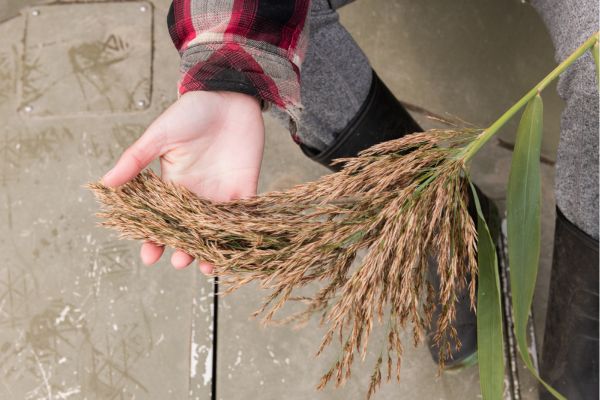
A River Institute staff displays the tufted seed head of a phragmites stalk near Long Sault. Photo by Stephany Hildebrand.
The St. Lawrence River Institute of Environmental Sciences (River Institute), South Nation Conservation (SNC), Raisin Region Conservation Authority (RRCA), and United Counties of Stormont, Dundas, and Glengarry (SDG Counties) are continuing coordinated efforts to address one of Canada’s most aggressive invasive species, Phragmites australis, through a collaborative project supported by the Ontario Phragmites Action (OPA) program’s Invasive Phragmites Control Fund (IPCF).
Non-native phragmites, also known as common reed, is a perennial grass native to Eurasia that has become increasingly common in Canada, where it aggressively outcompetes native plants, degrades habitats, damages infrastructure, and disrupts ecosystems. Phragmites grows in tall, thick clumps and is easily recognized thanks to its noticeable tufted seed head. The plant thrives in wet environments such as wetlands and roadside ditches.
“Roadside phragmites infestations are a common sight in all seasons for drivers in eastern Ontario,” says Scott Braithwaite, RRCA’s Stewardship and Planning Coordinator. “People may not realize how damaging this invasive plant can be. When left unmanaged, small patches can quickly turn into large monocultures.”
Building on the momentum of recent efforts in the Eastern Ontario Phragmites Management Area – one of a number of Phragmites Management Areas established in Ontario by the OPA program to support a coordinated response to phragmites – the River Institute, SNC, RRCA, and SDG Counties took further steps against phragmites in 2025. The partners focused on mapping phragmites locations, implementing various control activities in high-priority areas, and engaging the local community in managing and preventing the spread of phragmites.
“Invasive phragmites does not respect municipal or watershed boundaries,” says Michelle Cavanagh, SNC’s Special Projects Lead. “This project’s results show the value of regional collaboration, allowing partners to share data and take coordinated action across eastern Ontario.”
The project partners surveyed approximately 6,700 kilometres of roadways and over 3,400 acres of conservation land for invasive phragmites. The data collected through on-the-ground field surveys and aerial drone assessments were compiled into a shared, online web map that serves as a central resource for coordinating management efforts and tracking invasive phragmites across the region. The partners aim to use the data to guide future management efforts.
In 2025, the partners also undertook phragmites control activities using a combination of methods tailored to site conditions. These included selective herbicide application, manual removal, livestock grazing, and cultural practices such as planting native trees and vegetation to support long-term habitat restoration. Control efforts were implemented at several ecologically significant sites, including the Rotary Eco Gardens in Cornwall; the Leitrim Wetlands in Ottawa; and the Summerstown Wetland, Gray’s Creek Conservation Area, and Cooper Marsh Conservation Area in South Glengarry.
“On-the-ground control is about matching the right tool to the right site,” says Phil Duncan, SDG Counties’ Forestry Coordinator. “By assessing local conditions, we can choose approaches that are both effective and appropriate for sensitive environments.”
Supported by the Ontario Ministry of Natural Resources, the Invasive Phragmites Control Fund (IPCF) is coordinated by the Invasive Species Centre (ISC) and Nature Conservancy of Canada (NCC) through the OPA program. The fund aims to amplify local phragmites control initiatives and support the development of a coordinated, provincial scale phragmites program. The OPA program is making great strides in collaborative, efficient invasive Phragmites management through programs like the Invasive Phragmites Control Fund, genetic testing, biological control research, map creation, outreach and education, training, and resource creation.
“Community awareness and involvement remain important components of long-term regional phragmites management,” says Matt Windle, the River Institute’s Program Leader, Research and Technical Services. “Residents can help protect biodiversity and prevent the spread of invasive phragmites by reporting sightings through citizen science platforms such as EDDMapS or iNaturalist, cleaning vehicles and equipment before leaving natural areas, and planting native species that support local ecosystems.”
The views expressed here are those of the project partners and do not necessarily reflect those of the Province, ISC, NCC, or other OPA implementation partners.