

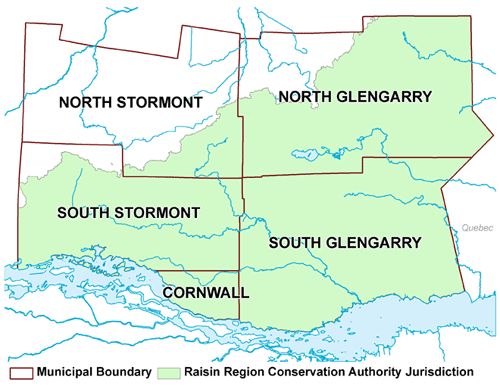
The Raisin Region Conservation Authority (RRCA) is a community-led, watershed-based natural resource management organization with a 1,680 km2 jurisdiction in eastern Ontario.
The RRCA was established in 1963 to address local flooding, drainage, and water supply issues. Today, the RRCA supports the five municipalities in its jurisdiction by protecting people and property from natural hazards like flooding and erosion, protecting sources of municipal drinking water, providing recreation and eco-tourism opportunities, fostering land stewardship, and conserving and enhancing environmentally significant lands.
The RRCA ensures that lives and properties are safe from the risks posed by flooding, erosion and other natural hazards. This is done by administering a provincial regulation made under Section 28.1 of the Conservation Authorities Act; the Development, Interference with Wetlands and Alterations to Shorelines and Watercourses (Ontario Regulations 41/24). Under the provincial regulation, RRCA reviews and approves development proposals subject to Conservation Authority policies addressing provincial standards for the preservation of natural features and protection from potential hazards like floodplains, bluffs, wetlands, rivers, lakes and drains in order to prevent injuries and loss of life, minimize property damage and restoration costs, protect adjacent and downstream properties from harm cause by upstream development, reduce the costs of emergency operations and evacuations, minimize the hazards and expenses associated with development in floodplains and areas that are susceptible to flooding and/or erosion, and protect the critical natural benefits of wetlands, watercourses, and shorelines.
The RRCA participates actively in the municipal planning process and makes recommendations to local decision-makers respecting conformity to provincial policies and the effects of their decisions respecting land use, development, and drainage.
The RRCA currently owns and manages over 2,000 acres of environmentally significant land to preserve sensitive habitat, strengthen forest cover, and enhance watershed health and resilience. RRCA’s three publicly accessible Conservation Areas welcome over 150,000 visitors each year. RRCA is a qualified land donation recipient under Canada’s Ecological Gifts Program.
Through its stewardship programs, the RRCA works with public and private landowners to implement environmental restoration projects on their land, such as creating and enhancing wetlands, grasslands, forests, riparian buffers, windbreaks, and more. Through its forestry programs, the RRCA has planted over 1.3 million trees since 1994.
The RRCA, alongside government and community partners, has completed multiple habitat restoration projects within the St. Lawrence (Cornwall/Akwesasne) Area of Concern (AOC), which encompasses over 70 percent of the RRCA’s jurisdiction.
The RRCA hosts the program coordinator and is the legal entity for the ALUS Ontario East program, which works with local farmers to establish and maintain nature-based solutions on their land to enhance biodiversity and climate change resilience.
The RRCA is a not-for-profit organization governed by a municipally appointed board of directors.
Member Municipalities
The RRCA has five member municipalities: the Townships of North Glengarry, South Glengarry, North Stormont, South Stormont, and the City of Cornwall. There are eight members on the Board of Directors: two each from the City of Cornwall, South Stormont and South Glengarry, and one from North Stormont and North Glengarry.
Vision
The vision of the Raisin Region Conservation Authority is:
“Working with our community for a better environment and healthy future.”
The RRCA is committed to the development and implementation of action plans in order to achieve this vision. The RRCA mission statement has been developed to guide staff in their day-to-day activities and in their planning for the future.
Mission
The mission statement of the RRCA is:
“To guide our community in the protection, enhancement and restoration of our natural environment through programs that balance human, environmental and economic needs for a sustainable future.”
RRCA Subwatersheds Map
