

August 10, 2026
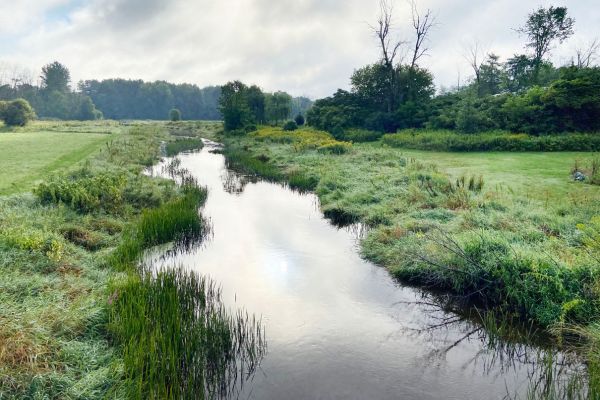
The Beaudette River near Glen Roy in South Glengarry on August 11, 2026.
Residents in the Raisin Region Conservation Authority’s (RRCA) watershed will remember last year’s unprecedented drought, when hot temperatures and low precipitation prompted the conservation authority to declare a Level 1 Low Water Condition on August 12, 2025. RRCA’s Water Response Team later upgraded the status to Level 2 on September 18 and Level 3 on October 30.
So far this summer, above-average precipitation has helped maintain stream flows and water supplies within the normal range across the region. Precipitation over the past three months was 139% of average, while the first nine days of August brought 57 mm of rain – 186% of the average for that period. Despite the wet start to the summer, the RRCA encourages residents and farmers to continue making water conservation a regular practice to help protect local water resources.
“By using water more efficiently, we can give our groundwater more time to recharge, helping improve our watershed’s resilience to future droughts,” says RRCA Project Manager Laura Grant, who helps coordinate RRCA’s Low Water Response Program. “We also encourage residents in drought-prone areas, particularly those who rely on private wells, to plan ahead for periods of low water by increasing their water conservation efforts as soon as stream flows and precipitation begin to decline.”
As part of its Low Water Response Program, the RRCA monitors local conditions and forecasts and advises municipalities when low water indicators emerge. A Level 1 Low Water Condition is declared when monthly stream flows fall below 70% of the lowest average summer-month flow, or precipitation falls below 80% of average
Some ways residents can incorporate water conservation into their daily routines include repairing leaky taps and toilets, installing low-flow showerheads, collecting rainwater for gardens, and reducing non-essential water use, such as lawn watering and car washing. Farmers can also conserve water by checking irrigation systems for leaks and irrigating later in the day or in the evening to minimize evaporation. Additional water conservation tips and resources are available at rrca.on.ca/LowWater.
“Water conservation also provides economic and environmental benefits,” adds Grant. “Reducing water use lowers the energy needed to pump, heat, and treat water. It can also improve the efficiency of septic systems and help extend their lifespan.”
Residents can also help the RRCA monitor the local impacts of low water conditions by completing the Water User Feedback Form available at rrca.on.ca/LowWater. For more information, visit rrca.on.ca or contact the RRCA at (613) 938-3611 or info@rrca.on.ca.