

August 14, 2026
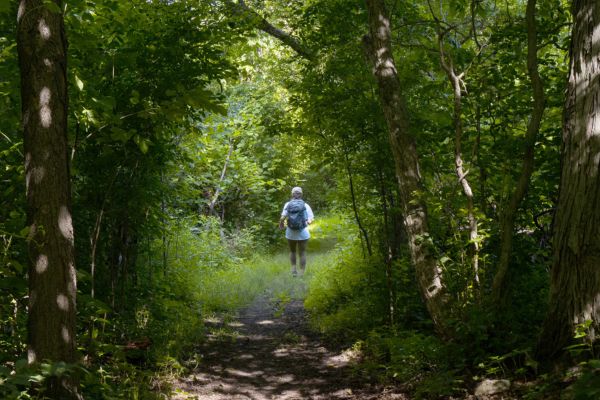
A visitor explores the trails at Gray's Creek Conservation Area.
Visitors exploring the nature trails at the Raisin Region Conservation Authority’s (RRCA) Conservation Areas have an easy way to identify and learn about the plants, animals, and insects they come across. With the free iNaturalist app, a smartphone can become a handy field guide.
The app uses photos to help identify species, while observations can also be recorded and contributed to an online database. For the RRCA, these observations provide valuable information that helps staff better understand and monitor biodiversity at Cooper Marsh, Charlottenburgh Park, and Gray’s Creek Conservation Areas.
“This technology gives people a simple way to slow down, look closely at their surroundings, and become more curious about the natural world,” says Scott Braithwaite, RRCA’s Stewardship and Planning Coordinator. “Whether you’re an experienced naturalist or someone who simply wonders what that bird, flower, or insect is, the iNaturalist app can help turn that curiosity into discovery.”
Observations made within the RRCA’s Conservation Areas are automatically added to dedicated databases for each site. Together, these records create an ongoing, publicly accessible biological survey that provides a snapshot of the species found throughout the properties. The information is available online at rrca.on.ca/CitizenScience.
“Every observation adds another piece to the picture of the biodiversity within our Conservation Areas,” says Braithwaite. “What might feel like a small contribution from an individual visitor can become useful information when thousands of observations are collected over time.”
To date, more than 7,800 observations have been recorded across the RRCA’s three Conservation Areas, helping contribute to the organization’s conservation and monitoring efforts.
The RRCA currently conserves and maintains more than 2,000 acres of environmentally significant land, including its three publicly accessible Conservation Areas. These lands help protect ecologically sensitive habitat, strengthen regional tree cover, maintain green infrastructure for flood resilience, and provide opportunities for recreation and eco-tourism. RRCA's Conservation Areas offer over 20 km of nature trails available throughout the year at no cost.
Visitors interested in participating in this citizen science initiative can find information about downloading and using the iNaturalist app at rrca.on.ca/CitizenScience. For more information, contact the RRCA at (613) 938-3611 or info@rrca.on.ca.