

Status: Normal
Watershed conditions have returned to normal
Thursday, December 8, 2016 (10:00 AM)
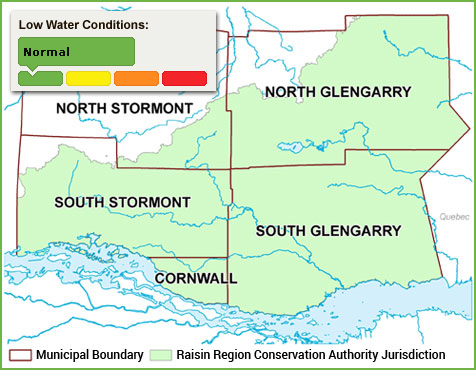
At the end of November, the waterhsed had received enough precipitation to bring the moving 3-month average to over 80% of normal. All three lakes in North Glengarry (Loch Garry, Middle Lake and Mill Pond) are currently within their normal operating levels. Flows in the Raisin River as well as local tributaries are in the normal range for this time of year. We have not received any new notifications of dry or stressed wells in our area. At this time, there is sufficient evidence to return the low water condition status to "Normal".
Water User Feedback Form
Were you impacted by low water (i.e., did your well go dry)? Please help the RRCA gauge local impacts of low water by filling out our water user feedback form.
Water Conservation Tips
- Repair any leaks in your home (e.g. taps and toilets)
- Reduce non-essential water usage such as lawn watering or car washing
- Only wash full loads of laundry or dishes
- Install a low consumption showerhead
- For farmers: monitor your irrigation systems for leaks, and consider irrigating closer to the evening to reduce evaporation loss
Resources for Residents with Private Wells
- Low Water Resources Info Sheet
- Types of wells
- What to do when your well goes dry (and when water returns)
- Never put water into your well – this could damage the well or contaminate groundwater
- Consider bulk water haulage services that provide water and storage tank rentals
- Learn about groundwater, private water supplies and the different types of private rural water wells: ontario.ca/page/private-rural-water-supplies
- Tips for managing your well in times of water shortage: ontario.ca/page/managing-your-water-well-times-water-shortage
- Contact the Ontario Ministry of the Environment, Conservation and Parks - Water Well Help Desk (Phone: 1-888-396-9355 Email: wellshelpdesk@ontario.ca
- Contact a licensed well contractor if you need to do work on your well: ontario.ca/page/find-licenced-well-contractors
- Well Disinfection Tool: Provides an easy way to calculate the amount of cholorine produced needed to disinfect a well
- Private wells: Drinking water safety during and after a power outage
Water Conservation Fact Sheets
- Conserving Water Inside your Home
- Conserving Water Outside your Home
- Conserving Water on your Farm
- Managing your Well
- Water Smart – Protecting Water from Source to Tap
About Low Water Response and the RRCA
The Ministry of Natural Resources (MNR) manages water use during a drought. Ontario’s Low Water Response Program ensures provincial and local authorities are prepared in the event of low water conditions. The Raisin Region Conservation Authority assists the ministry by assessing local watershed conditions and notifying residents.
The Raisin Region Conservation Authority monitors precipitation and water levels throughout Cornwall; South Glengarry; and large portions of North Glengarry and South Stormont.
About Low Water Notices

Normal
Flows are in the normal range and precipitation accumulation has been close to average.

Level 1
Flows are less than 70 percent of their normal summer low flow and/or precipitation has been less than 80 per cent of average. Water users are asked to voluntarily reduce consumption by 10 per cent.

Level 2
Flows are less than 50 percent of their normal summer low flow and/or precipitation has been less than 60 per cent of average. The Ministry of the Environment, Conservation and Parks will send letters to holders of Permits to Take Water to ask them to voluntarily reduce their consumption by 20 per cent.

Level 3
Flows are less than 30 percent of their normal summer low flow and/or precipitation has been less than 40 per cent of average. There is also potential for economic harm to water takers and/or significant harm to the ecosystem. The Water Response Team may ask the province to impose mandatory restrictions on those holding Permits to Take Water.
In the event of a low water status of anything other than normal, the RRCA will issue a media release and advise our member municipalities. A local Water Response Team will be convened to inform the MNRF and the public.